 Nash
Nash connects a self-custody crypto wallet with euro transfers and payments
Nash combines a self-custody crypto wallet with token swaps, euro buying and selling, and payment services in one app. Self-custody means you control the keys that authorize crypto transfers. The fiat ramp connects supported assets to euros, while an IBAN account handles cash payments. DeFi earnings and card spending add separate functions with their own conditions. Identity checks, residence eligibility, and the selected service determine which functions you can access.
Crypto storage, swaps, and euro payments
The wallet stores and transfers crypto, while a token swap changes the asset held. Buying or selling through the fiat ramp crosses between crypto and euros. An IBAN, or International Bank Account Number, identifies the account used for cash transfers.
Wallet support includes Bitcoin, Ethereum, Solana, and several other networks. Support for a chain does not establish that every asset has the same purchase, swap, or payment options. WalletConnect connects the wallet to compatible decentralized applications. Nash Bridge adds transfers across supported EVM networks, where EVM means Ethereum Virtual Machine. A Unified EVM Wallet option lets accounts use the same EVM private key.
Wallet signing and recovery
Nash derives its wallet keys from a 12-word recovery phrase. The phrase gives access to the underlying crypto accounts. Keeping its backup separate from everyday login credentials preserves a recovery option if account access fails. An account password and the wallet's recovery phrase serve different purposes.
Co-signing and access rules
Multi-party computation (MPC) lets the user and the service contribute to a valid transaction signature. During this signing process, neither party reconstructs the complete private key. Configurable withdrawal limits and approved-address lists apply to this path. A person who obtains a full private key can sign outside these account controls.
Backup and recovery
Forgotten passwords
Password recovery requires the twelve secret words. If the password is forgotten and the phrase is unavailable, the password reset process cannot restore account access.
Exposed keys
A compromised private key puts the corresponding blockchain assets at risk. Restricting exchange access cannot prevent transfers signed with that key elsewhere. A recovery phrase also grants control over the accounts derived from it, so sharing it exposes more than one account credential.
Euro purchases and personal IBAN transfers
The fiat ramp buys and sells supported crypto for euros. Fiat services require identity verification. An eligible personal IBAN account provides a euro balance alongside the crypto wallet, with SEPA and instant SEPA transfers, salary deposits, and payment functions. SWIFT transfers are unsupported and return to the sending bank.
Purchases can use the euro account, supported instant bank methods, or manual SEPA transfers. SEPA means Single Euro Payments Area. Instant processing requires support from the relevant banks and payment route. The account also supports automatic conversion of portions of incoming deposits into crypto, where that function is available.
Modulr Finance B.V. provides the euro account and related payment services. Modulr keeps the money backing these accounts separate from its operating funds. This electronic-money safeguarding differs from bank deposit insurance. The Dutch Deposit Guarantee Scheme does not cover the account. An insolvency process can involve deductions for returning funds when other resources cannot cover those costs.
Token swaps and the separate order-book exchange
The in-app swap integration routes trades through ODOS on supported EVM networks and Jupiter on Solana. Available liquidity, the selected asset pair, and network costs influence the quote. A swap returns a crypto asset. Selling through the fiat ramp serves a different purpose because it produces euros.
The Layer-2 order-book exchange has a separate trading wallet and matching system. Funds allocated there differ from assets in the personal wallet, and transfers between them can incur network fees. The order-book API remained supported in the April 2025 product update, which also confirmed that this exchange was separate from the mobile app's swap experience. Its maker and taker pricing should not be applied to in-app swaps.
Costs follow the selected operation
The total cost depends on the operation, asset, network, and payment method. Ramp charges, swap charges, and blockchain fees have different bases. The published service fees exclude blockchain costs, and the exchange rate also affects the amount received.
Funding a euro payment from crypto
In this hypothetical example, you hold a supported crypto asset and need enough euros in an eligible, verified IBAN account to cover a payment.
Compare a token swap with selling the asset into the euro account. For each, examine the output currency, service charge, network cost, and amount received. The swap leaves you holding crypto and does not credit euros to the IBAN account. A supported sale can credit euros, with its exchange rate and charges determining the usable proceeds.
You select the sale only if its net proceeds cover the intended payment. In this case, the completed sale credits enough euros to the account. A quote or a submitted sale alone would not establish that the required euro balance exists.
DeFi earnings and their distinct exposure
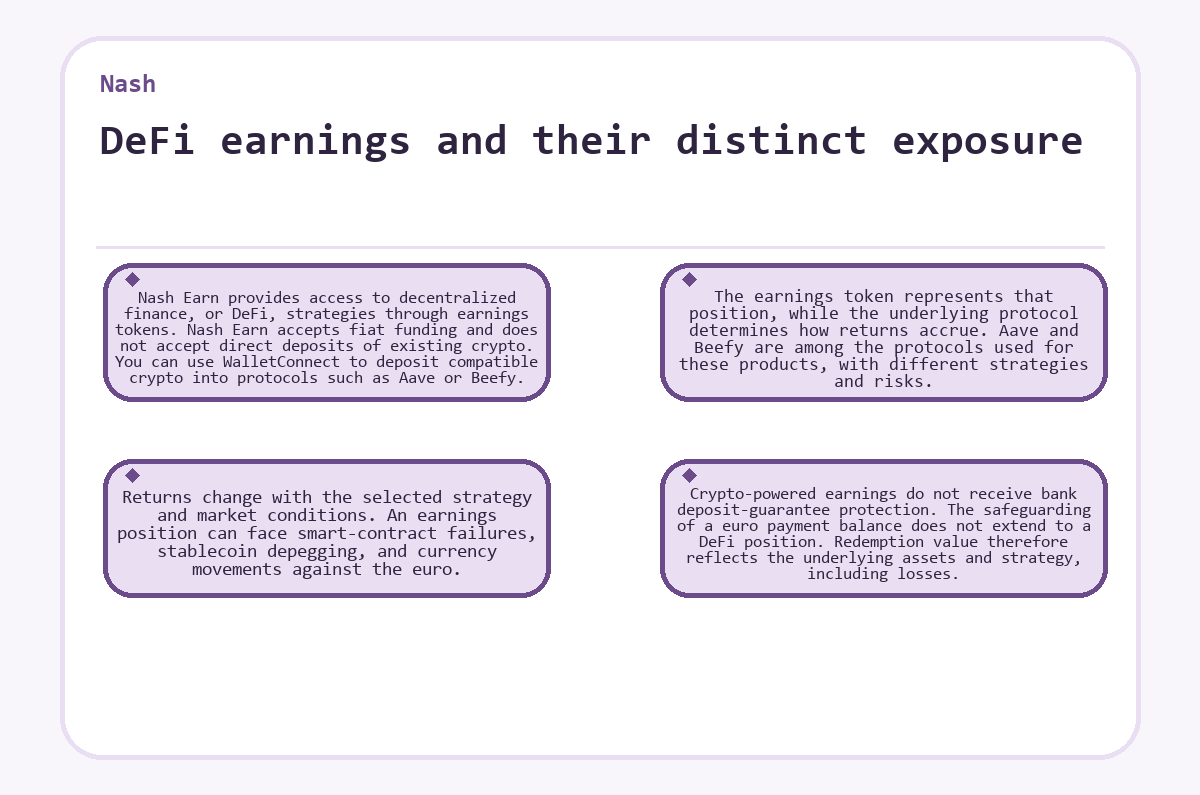
Nash Earn provides access to decentralized finance, or DeFi, strategies through earnings tokens. Nash Earn accepts fiat funding and does not accept direct deposits of existing crypto. You can use WalletConnect to deposit compatible crypto into protocols such as Aave or Beefy. The earnings token represents that position, while the underlying protocol determines how returns accrue. Aave and Beefy are among the protocols used for these products, with different strategies and risks.
Returns change with the selected strategy and market conditions. An earnings position can face smart-contract failures, stablecoin depegging, and currency movements against the euro. Crypto-powered earnings do not receive bank deposit-guarantee protection. The safeguarding of a euro payment balance does not extend to a DeFi position. Redemption value therefore reflects the underlying assets and strategy, including losses.
Card spending and automatic crypto purchases
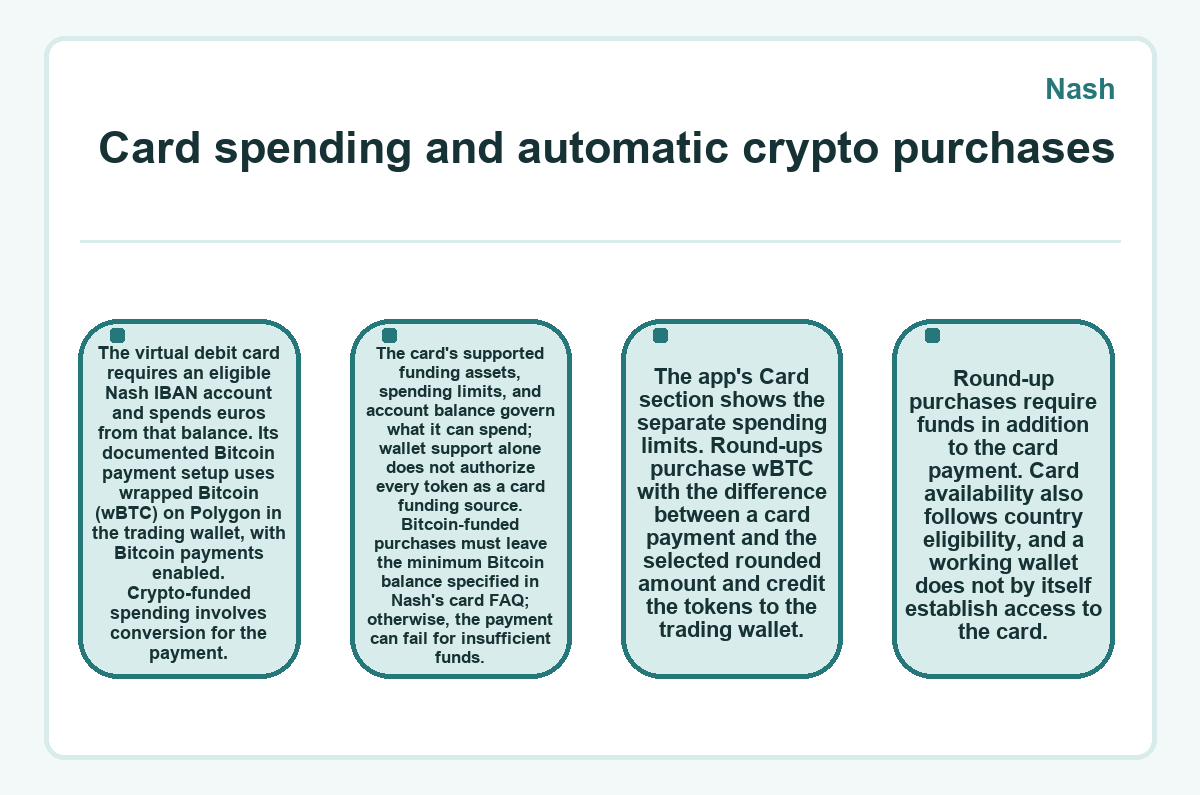
The virtual debit card requires an eligible Nash IBAN account and spends euros from that balance. Its documented Bitcoin payment setup uses wrapped Bitcoin (wBTC) on Polygon in the trading wallet, with Bitcoin payments enabled. Crypto-funded spending involves conversion for the payment. The card's supported funding assets, spending limits, and account balance govern what it can spend; wallet support alone does not authorize every token as a card funding source. Bitcoin-funded purchases must leave the minimum Bitcoin balance specified in Nash's card FAQ; otherwise, the payment can fail for insufficient funds. The app's Card section shows the separate spending limits.
Round-ups purchase wBTC with the difference between a card payment and the selected rounded amount and credit the tokens to the trading wallet. Round-up purchases require funds in addition to the card payment. Card availability also follows country eligibility, and a working wallet does not by itself establish access to the card.
Identity checks, service access, and NEX
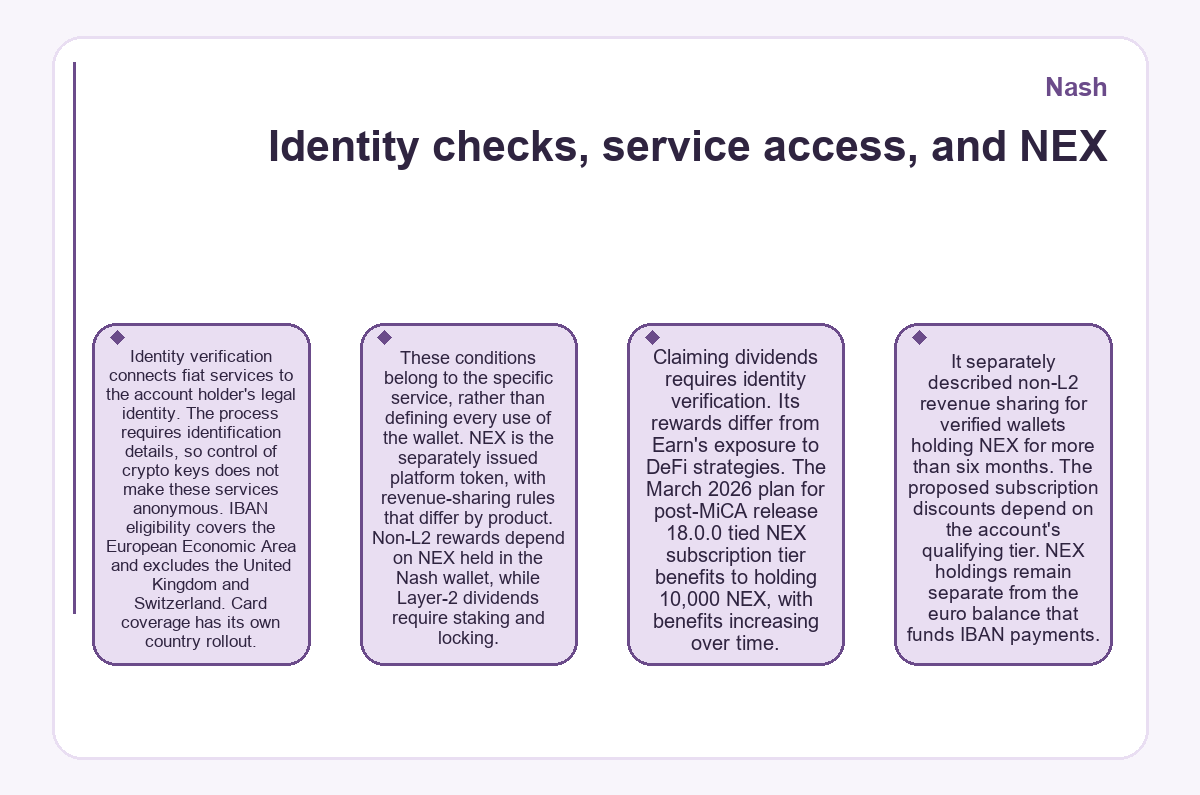
Identity verification connects fiat services to the account holder's legal identity. The process requires identification details, so control of crypto keys does not make these services anonymous. IBAN eligibility covers the European Economic Area and excludes the United Kingdom and Switzerland. Card coverage has its own country rollout. These conditions belong to the specific service, rather than defining every use of the wallet.
NEX is the separately issued platform token, with revenue-sharing rules that differ by product. Non-L2 rewards depend on NEX held in the Nash wallet, while Layer-2 dividends require staking and locking. Claiming dividends requires identity verification. Its rewards differ from Earn's exposure to DeFi strategies. The March 2026 plan for post-MiCA release 18.0.0 tied NEX subscription tier benefits to holding 10,000 NEX, with benefits increasing over time. It separately described non-L2 revenue sharing for verified wallets holding NEX for more than six months. The proposed subscription discounts depend on the account's qualifying tier. NEX holdings remain separate from the euro balance that funds IBAN payments.
Quick answers about Nash
Is buying crypto directly into an external wallet possible?
The Nash Widget supports purchases delivered to a user-controlled external wallet. This differs from the standard in-app purchase that sends assets to the personal wallet. The chosen wallet must support the asset and its network. External delivery does not remove fiat-service identity checks or payment eligibility requirements.
How long does a manual SEPA purchase take?
A manual SEPA transfer for a Nash purchase can take one to four business days to complete. An instant SEPA transfer uses a faster route when the sending bank supports it. Bank-transfer completion and the final crypto purchase remain distinct, especially when a changed quote requires confirmation before the order can proceed.
Will a purchase quote stay fixed while a bank transfer clears?
A manual-transfer purchase quote can change before the funds arrive. A favorable market move gives the buyer an improved rate. If the original quote can no longer be honored, the buyer can confirm or reject a replacement quote. Sending the bank transfer therefore does not lock the original crypto amount.
Where can I view the private keys for individual assets?
Individual asset keys can be displayed in the Nash web platform under My profile and Accounts. The browser decrypts them locally, and the mobile app does not provide the same display function. Revealing or importing a full key elsewhere exposes that account beyond the platform's MPC signing controls.
How can I obtain a euro account statement?
Contact Nash support to request a statement for the euro account.
Does a linked bank account have to be in my name?
The name on a linked bank account must match the name on the verified account. Linking requires proof of ownership through an account document, a deposit into the Nash IBAN account, or a purchase at or above the verification minimum specified in Nash's bank-linking instructions. The first deposit into the euro account must also come from a bank account in your name. Once that initial funding is complete, the account can receive transfers from other payers.
Why is a received token missing from the wallet display?
A token can be missing because the portfolio display has not added it automatically. An absent entry alone does not prove an on-chain transfer failed. The chain, destination address, and transaction status still matter. Nash support can add a token to the display for a supported wallet account.
Can I add the debit card to Google Wallet?
The Nash debit card supports Google Wallet on Android, with Google Pay support introduced in 2025. This enables contactless payments using an eligible card. Access still depends on the card service's requirements.